See what your knowledge knows.
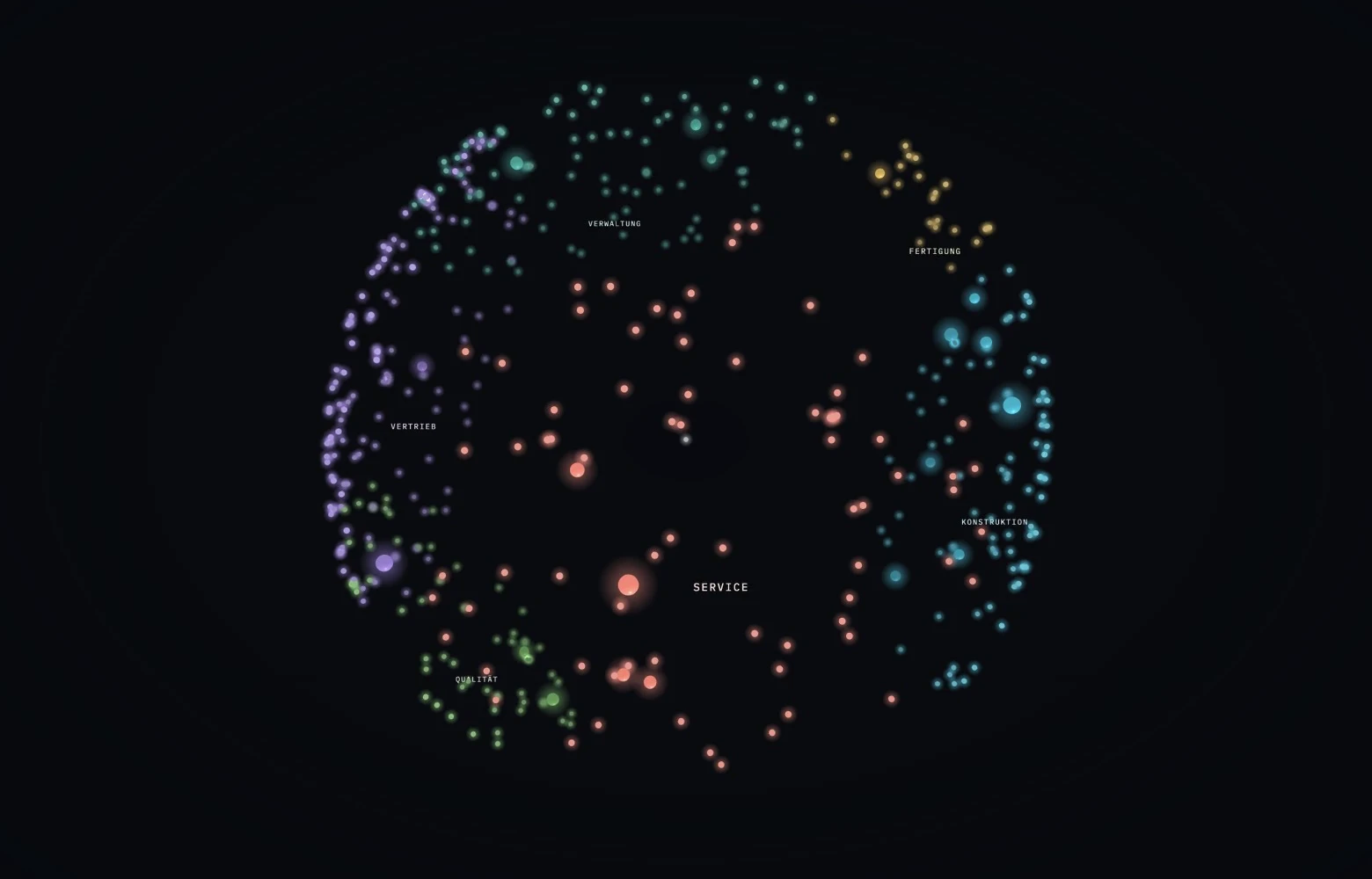
The Spatial Knowledge System makes your prepared knowledge base visible and interactive: a spatial knowledge graph across your records. Curated selection → typed AI operator → citable artefact → new knowledge node. Knowledge that builds on itself under human control. The 3D view is only the surface; this cycle is the real product.
Answers with sources, or no answer at all.
Give ChatGPT access to company knowledge and you may get fluent answers with invented details slipped in. SKS draws on relevant passages from a carefully chosen selection of your documents and produces answers with sources. You can then check what an answer is based on.
Your records as a landscape, not a list of search results.
Related information draws together, gaps and contradictions stand out, and important material has visible weight. You select the material by hand, the operator processes your selection and the result becomes a new node in your knowledge graph.
Runs on your systems. Stays on your systems.
Local language models, processing on your systems and clear safeguards for sensitive content.
The SKS is the fifth of five stages.
Frequently asked questions about the product.
How does the AI access our knowledge?
Through indexed, read-only access to your files; new content is created as separate, labelled artefacts.
How does SKS make AI answers verifiable?
SKS works with a carefully chosen selection of your documents and makes the sources it uses visible. You can trace and check the results before using them in your work.
What is RAG, and is that what SKS is?
RAG is the underlying technique. SKS adds curation, typing, an audit trail and local processing: RAG that stands up to an audit.