Your most valuable data? The data no one can find any more.
Repertadata makes confidential legacy records in small and mid-sized businesses searchable and usable – with local AI, without the cloud. For the pilot, we process a defined subset of your records, at our site or on your systems.
Local AI, human oversight, verifiable evidence.
AI automation that stands up to an audit.
Repertadata in 87 seconds.
From the protected intake of a collection, through processing, to working in the Spatial Knowledge System.
For our demos we use synthetic sample collections only – for good reason: we never demonstrate with real customer data. That, too, is governance.
Your business has a memory. But no way to access it.
Most business data is unstructured: scans, folders, legacy systems and inboxes. This ‘dark data’ contains contracts, engineering knowledge, inspection histories, client files and patient records: precisely the knowledge new colleagues look for, audits use as evidence and AI projects need. The usual answer is the cloud. We want a different approach for confidential records: 85% of German businesses consider dependence on US cloud providers too high, and 91% prefer providers from Germany (Bitkom Cloud Report 2026). Your most sensitive data does not belong in someone else’s data centre, not even for AI. Your staff know the result: searching rather than finding, in folders, scans and legacy systems that were never made searchable.
We sit between cloud platforms and isolated tools.
Enterprise platforms govern well, but in the cloud, heavyweight and expensive. Local AI tools are private, but offer no governance, no evidence and no pipeline for legacy records. Repertadata brings together what hasn't come together before:
Processing with local models, in our environment or yours, as agreed for the project. Your document contents stay out of the cloud during this processing.
The Sensitivity Gate and human approvals are architecture, not a statement of intent.
Typed AI operators perform defined tasks and produce verifiable results you can cite, not chat answers without sources.
Built for the 15-year archive, not just tomorrow's inbox.
From classification to forecasting where the data allows it: numbers, not promises in prose.
Five stages. Each bookable on its own. Each with its own deliverable.
Taking stock: what do you have, where is it, and what is it worth? (The starting point: a 30-minute call.)
Data protection and governance findings on your records, with an action map.
A defined subset of your records, processed locally – at our site or yours: the proof on your real data.
Your full collection: classified, enriched with metadata, verified and searchable.
The prepared knowledge base becomes a working environment: spatial, linked to sources and auditable.
The AI Potential Analysis. We structure your records and diagnose where AI pays off. Where the data allows it, we add forecasts to the analysis. The result: an expert report you can cite, not an opinion.
Go to the AI Potential Analysis →See what your knowledge knows.
The Spatial Knowledge System makes your prepared knowledge base visible and interactive: a spatial knowledge graph across your records. Curated selection → typed AI operator → citable artefact → new knowledge node. The 3D view is only the surface; this cycle is the real product.
Go to the product →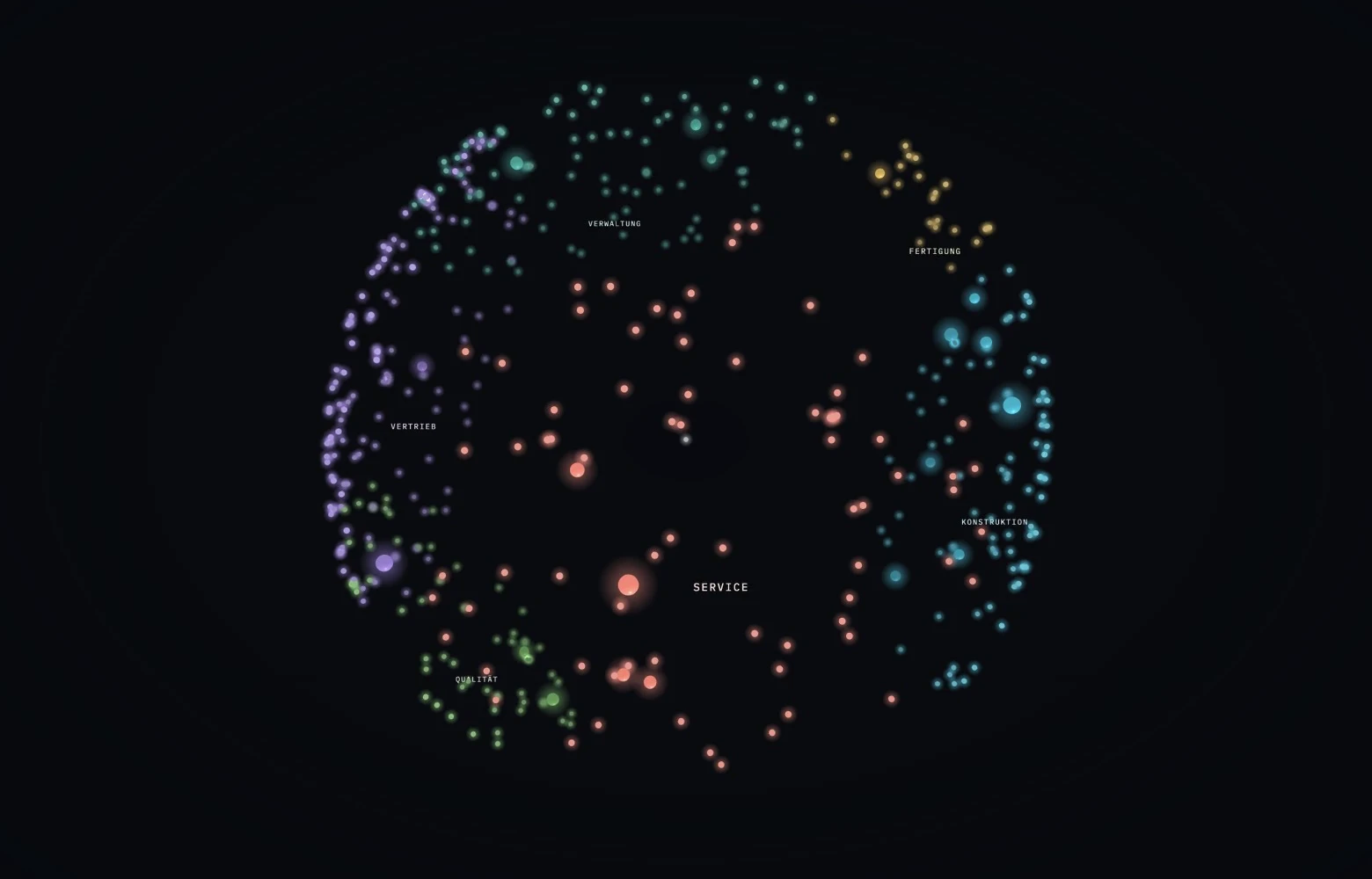
Compliance isn't a tax we pay. It's the architecture.
Sensitivity Gate: sensitive content stays on the device.
Human oversight: no invasive step without approval.
Audit trail: processing steps logged, results traceable.
Regulation built in: GDPR as the requirement, GoBD for tax-relevant documents, the EU AI Act and ISO/IEC 42001 as the frame of reference.
A real-world archive grown over almost two decades, several thousand documents and notes, was processed locally on our own archive: 100% metadata coverage1,0 sensitive items in the cloud, 0 data losses2, an unbroken audit trail.
1 4,695 notes with standardised metadata. 1,627 PDFs processed, 13.3 million characters indexed.
2 1,278 notes filed after human review without data loss.
Where confidential legacy records are part of everyday work.
Make legacy files searchable without client data leaving your premises.
When experienced people leave, their knowledge goes with them. Unless you capture it first.
Fewer binders, more care: residents’ records, digital and quickly to hand.
The move to electronic case files is decided. The legacy registry is the problem.
Three questions everyone asks us.
How do scanned documents and PDFs become searchable?
Local optical character recognition (OCR) and AI classification make even 20-year-old scans searchable by their full text and sortable by content. We use local models, with the pilot running in our environment or on your hardware. Your document contents stay out of the cloud during this processing.
Is using AI compatible with the GDPR?
Yes. What matters is an appropriate legal basis, clear safeguards and traceable processes. For this, Repertadata relies on local models, controlled data processing and an audit trail.
What does it cost?
Start with a free 30-minute Discovery call. After that, we work in separately bookable stages, each with a defined result, so you always know what you are buying. We will assess with you whether a consultancy funding programme might apply.
From south-west Germany. Grounded in practice.
Repertadata grew out of a real problem: a body of knowledge accumulated over decades that no tool could make accessible with the governance it needed. So we developed the method and turned it into a service. We are based in south-west Germany, with roots in the region’s tech and AI community.